Mini Chapter Fifteen
Butterfly
- A long butterfly spread involves buying a call (i.e. a call fly) each at a lower strike and higher strike while selling 2 calls at an intermediate strike – mid of the long calls strikes. One can also think of it as being long a bull spread and long a higher strike bearish spread (short a higher strike bull spread) at the same time with the intermediate strike being sold in both the bull and the bear spread.
- Note one can construct the same butterfly spread using Puts also very much in the same manner
- Another way to construct a fly is to think about being short a straddle (the ATM intermediate strike) and long a 35/25/15/10 delta (as an example) strangle or long out of the money put and call strikes.
- Important to remember on strike placement for a fly is it doesn’t capture the skew present in the vol surface. The quoted fly prices are computed as the average of the implied vols of the wings reduced by the ATM implied vol for the same tenor. The strike of a vanilla 25 delta call or a 25 delta risk reversal call would account for the skew and match the exact IV on the smile. A butterfly on the other hand by taking the average wing IVs assumes a symmetrical smile – undervaluing the vol of the strike on the skew and hence placing it closer to the ATM and overvaluing the vol of the strike on the flatter wing, placing it further away from ATM.
- The view expressed in a butterfly spread is of the underlying remaining range bound and realising a profit as long as the underlying remains within the 2 long call strikes range with the buyer losing upto their premium paid in case of a move of the underlying outside the strikes range.
- Since the upside is capped and downside is limited to the premium paid – this is a very conservative strategy and thus one would tend to pay a premium for buying the strategy.
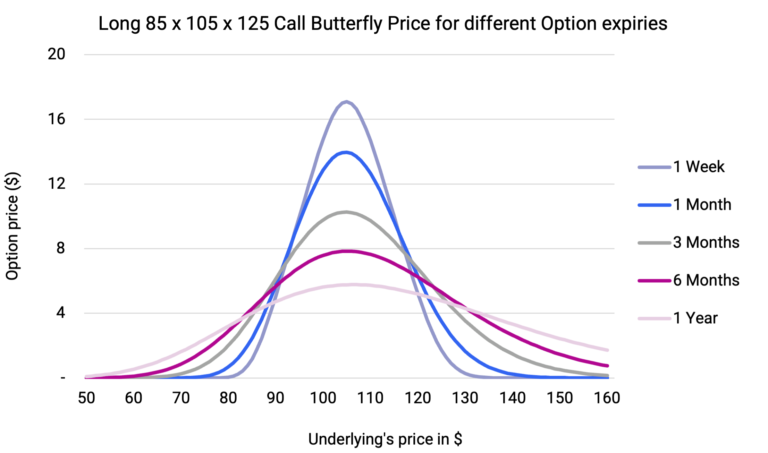
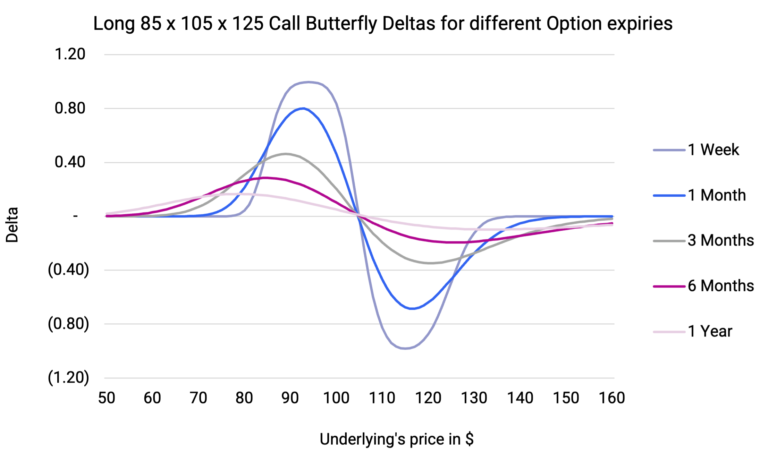
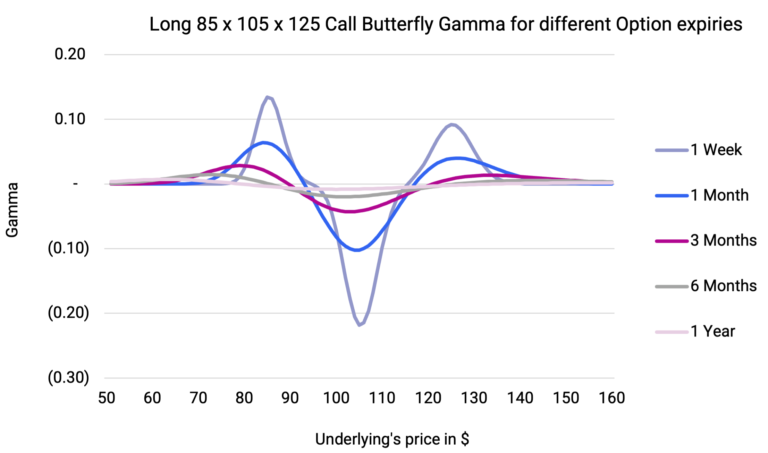
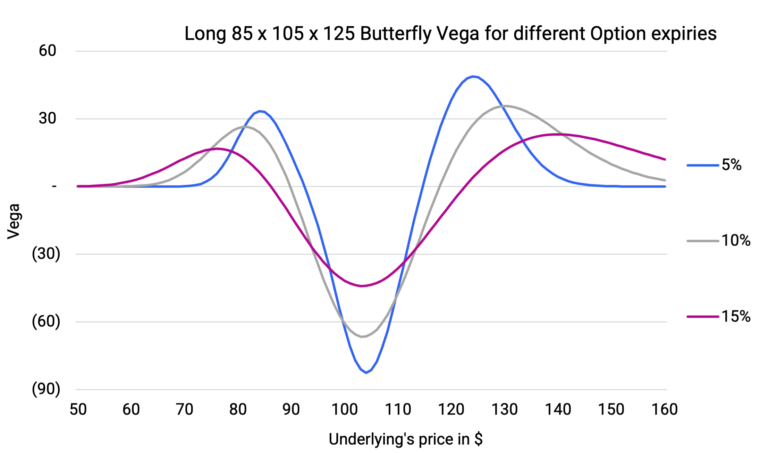
- Consider a graphical representation of the price and greek profiles of a 1 x 2 x 1 Call Fly (95 x 115 x 135) - chart at the bottom on the vega profile nicely denotes the long volga risk \[ ((\dfrac{\text{dVega}}{\text{dVol}})) \] at inception that’s maximum at the intermediate/ATM strike and flattens out for spot levels further away either side.
Graph 57 – Long Call Butterfly price across Option expiries
Source: Pandemonium.
Graph 58 – Long Call Butterfly Delta across Option expiries
Source: Pandemonium.
Graph 59 – Long Call Butterfly Gamma across Option expiries
Source: Pandemonium.
Graph 60 – Long Call Butterfly Vega across Implied Vols
Source: Pandemonium.


