
The short version
~13 min read. Part one found that institutional money calmed Bitcoin's ordinary days but never put a floor under its worst ones. This is why.
In June 2026, Bitcoin exchange-traded funds had their worst month on record: $4.40 billion of outflows, with the price near its lows for the year. By the last week of August the same funds were taking in $290 million a day, after a rally of roughly a third.
Same product, broadly the same investors, opposite behaviour. Something real did change in the wider world over those two months — part three is about what. But note the sequence: the money left at the low and arrived after the move.
Two things are worth separating here.
The first is an observation. ETF money has consistently arrived after strength and left after weakness. Why comes down to governance, career risk and how allocation decisions get made, and the next section takes those in turn.
The second is what isn't there to offset it. In most mature asset classes some money is obliged to buy when prices fall — an index fund replicating a benchmark, a mandate rebalancing to a target weight. It holds no view, and leans against the crowd by construction.
There is no rule anywhere that obliges anyone to own Bitcoin.
So nothing offsets the pro-cyclical behaviour. It isn't one component of the flow; it is very nearly all of it — which answers the puzzle part one left open. This buyer base can smooth the ordinary days. It cannot put a floor under the extraordinary ones.
Here is that structure.
What changes as an asset class matures is not sentiment. It is who is doing the buying, and what obliges them to.
Stage one: the natives. Individuals, own money, no permission required and none available. Nobody can be fired for owning it, because nobody is anyone's agent. Bitcoin lived here until 2017.
Stage two: legitimation. A wrapper, custody, an audited price, eventually a legal classification. It feels transformative and produces less new money than it appears to, because it converts "I am not permitted" into "I am permitted if I choose" — a change in the option set, not the position. For Bitcoin it ran from the first regulated futures, launched by CBOE on 10 December 2017 and by CME a week later, to the first US-domiciled spot ETFs in January 2024. Canada had listed one nearly three years earlier, but US institutional money could not use it. Seven years, and the length is the point: legitimation is a queue of separate permissions, not an event.
Stage three: discretionary allocation. Every dollar needs a fresh decision from someone who reports to someone else. A committee meets, reviews the evidence, votes — and votes yes when recent evidence looks supportive, which means after a rally. This is where Bitcoin sits today.
Stage four: default allocation. The buyer is nobody. Money arrives because a rule requires it: an index replicated, a policy weight restored, a payroll contribution (a 401(k) deferral) landing in a fund the saver never chose. Price is irrelevant because nobody decided anything.
Three to four is not just a change of degree. It is a change in the flow regime itself.
Three mechanisms, and none of them require the participants to be unsophisticated.
No target weight, so no rebalancing bid. A 60/40 mandate buys equities in a drawdown because there is a 60% weight to return to. An asset with no policy weight has nothing to revert to; it simply becomes smaller, and no rebalancing report flags anything.
Rigour is itself pro-cyclical for a young asset. Its evidence base is its track record, so a drawdown mechanically raises measured volatility and lowers measured returns. A committee behaving impeccably is shown a worsening case for the asset exactly when it is at its cheapest. That is a consequence of good process, not a failure of it.
And career risk is asymmetric. At stage three you can be criticised for owning it into a drawdown, never for missing it. At stage four that reverses: deviation from a stipulated index weight becomes the thing requiring justification. Hence allocations clustering in the low single digits, whatever the analytics recommend.
Which returns us to June and August 2026, where the flows reflect not a failure of nerve but a structure without a stabiliser.
The ownership base explains why the price swings are as violent as they are — and the right place to look is the ETF complex rather than Bitcoin as a whole.
That is a narrower lens on purpose. The funds hold roughly 5-6% of all Bitcoin; the rest sits in self-custody, on exchanges, in corporate treasuries and in coins nobody can move. None of that can ever be subject to a mandate. The ETF is the one pool where rule-based buying could originate, which makes its composition the question worth asking.
Institutions filing 13F disclosures accounted for about 20.8% of US Bitcoin ETF assets in the first quarter of 2026, down from 24.7% in the fourth quarter of 2025. Advisors are the largest cohort within that — and an advisor is not allocator capital, it is household money being advised or managed by a professional.
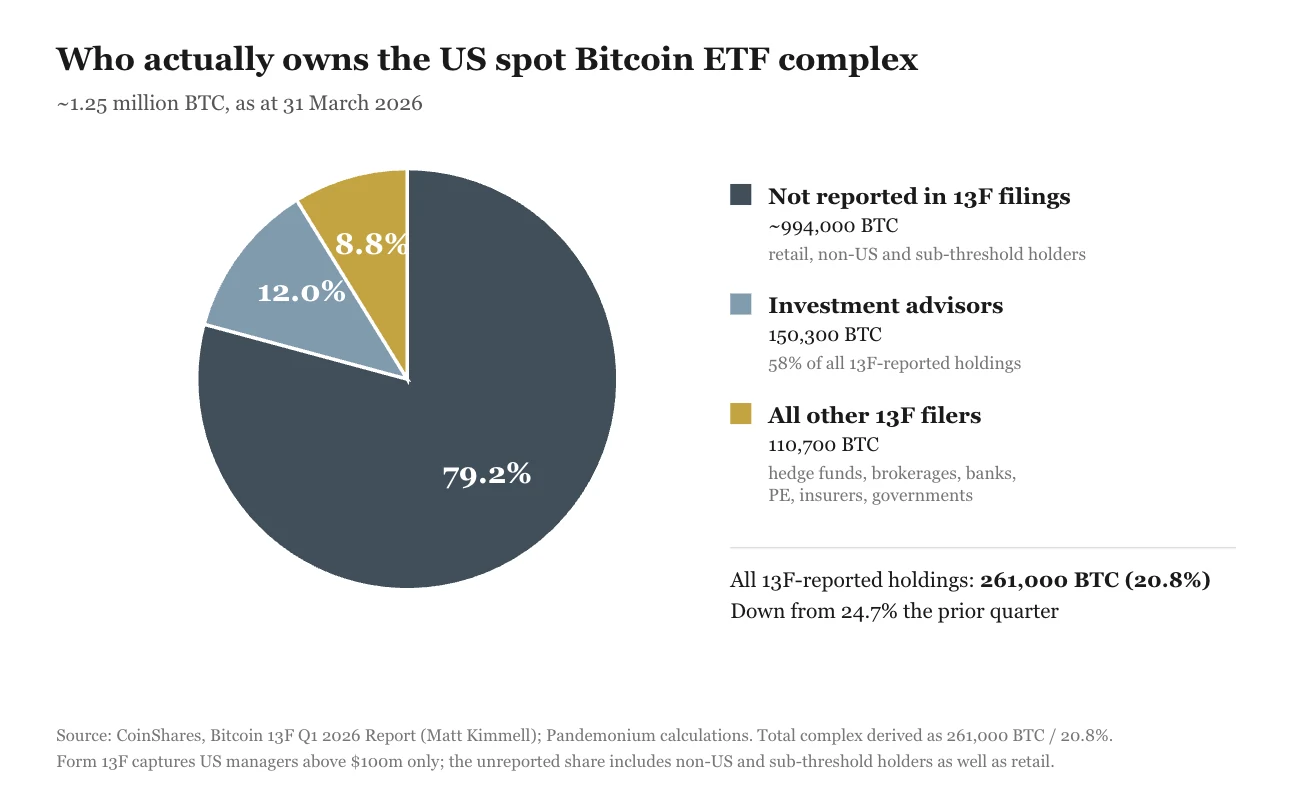
The unreported four-fifths is less a mystery than a category the filing rules never reach. Form 13F captures US managers running more than $100 million in eligible securities and nothing else — so retail accounts, advisory firms below that threshold, and every non-US institution sit outside it by construction. CoinShares' review of the equivalent data a year earlier concluded that most of that residual was retail investors and smaller firms.
Which sets up the point properly. Of the money that is genuinely institutional, most of it is wealth management. Advisors held 150,300 Bitcoin through these ETFs at the end of March — 58% of everything 13F filers reported. Hedge funds, brokerages, banks, private equity, insurers and sovereign funds share the other 42% between them.
The aggregate flow figures conceal the more interesting split. In the first quarter of 2026, hedge funds cut ~39% and brokerages ~53% — together 95% of the entire reduction — while advisors trimmed just ~6%, and banks, governments, private equity, family offices and insurers all added.
Much of the "institutional" flow was never a Bitcoin view at all. A large share of hedge fund Bitcoin exposure in 2024–2025 ran as cash-and-carry: buy spot (or a spot ETF), sell CME Bitcoin futures, and harvest the contango as a synthetic yield. This trade was attractive as long as the annualised futures basis stayed well above risk-free rates. By mid-2026 the basis had compressed and perpetual funding rates had turned deeply negative, so the spread no longer paid versus Treasuries and many funds unwound. That capital was effectively renting an interest rate, not expressing a directional view. Counting those inflows as "adoption" on entry and "lost faith" on exit is a category error at both ends.
The average holder has become longer-term. The marginal buyer has not. Strong hands own it. Weak hands price it.
The first permission was the wrapper. It arrived on 11 January 2024, when the first US spot Bitcoin ETFs began trading.
The second was the legal classification, tidied up on 17 March 2026, when the SEC and CFTC jointly identified a list of tokens — Bitcoin among them — as commodities rather than securities. It replaced a 2019 SEC staff framework carrying the usual disclaimer: not a rule, not the Commission's position, no protection for anyone relying on it. Useful as a signal, worthless as a defence.
But an interpretation binds agencies, not courts, not private plaintiffs, and not the next set of commissioners. Settling that is what the CLARITY Act, the digital-asset market-structure bill, is meant to do, and it is not law.
Bitcoin needs it less than most. Its status was never seriously in doubt — no promoter, no common enterprise, nothing for a securities claim to attach to — and SEC chairs of both parties have said so. The CFTC has called it a commodity since 2015, two federal district courts agreed in 2018, and regulated futures have traded since December 2017. None of that is binding precedent, but the legislation matters far more for the long tail of tokens than for Bitcoin.
The third is the right of a fiduciary to actually use the other two. It is the one that matters, and it has not arrived.
Anyone managing other people's retirement savings can be sued personally if a holding is later judged imprudent. That liability, not conviction, is what keeps new assets out: the binding question is never whether Bitcoin is a good investment but who gets sued if it isn't. Legal cover comes first; money follows.
That cover is still a draft, and it is moving slowly.
| Date | What happened |
|---|---|
| 7 Aug 2025 | Executive Order 14330 directs the Labor Department, SEC and Treasury to open 401(k) plans to alternative assets — digital assets named explicitly |
| 3 Feb 2026 | The order's own 180-day deadline passes with nothing proposed |
| 30 Mar 2026 | The Department releases its proposed rule, published in the Federal Register the next day |
| 1 Jun 2026 | Comment period closes, with more than 20,000 comments filed |
| End 2026 | The Department's stated target for a final rule. No applicability date has been given |
Even that understates it. A final rule needs a further White House review of at least thirty days, and a safe harbour only helps once courts confirm it protects what it claims to — so the consensus is that fiduciaries will wait for judicial validation before adding alternatives at all. That could take years. As of mid‑2026, there was no widely adopted, compliant digital‑asset option in U.S. workplace plans under the new framework.
Stage four is absent altogether. Bitcoin is not a constituent of any benchmark that institutional money tracks.
Nor has the progression been one-way. The December 2017 futures listings were a real step into stage two, and they coincided almost exactly with the cycle top. Then 2022 and 2023 ran it backwards: FTX destroyed the custody case, the banking rails were cut, and enforcement replaced rulemaking. Permission can be withdrawn as well as granted.
Crypto reaches for it constantly: equities were once disreputable too, and look at them now. The comparison is half right, and the half that fails is the important one.
Where it holds. US equities were once unsuitable for anyone with a fiduciary duty — in 1952 only 6.5 million Americans owned any, about 4.2% of the population. Four regulatory steps over fifty years changed that: pension legislation in 1974, a 1979 reinterpretation admitting pension money to small caps, real estate and commodities, a 1992 rule on participant-directed plans, and the 2006-07 reform making target-date funds the automatic default.
That last step is the one worth stealing. Target-date funds existed from 1994 and went nowhere for thirteen years. Then the 2006 pension reform let employers enrol workers automatically, and the Labor Department specified what qualified: a target-date fund carried legal protection, a money market fund did not. Assets ran from $5 billion in 2000 to $734 billion by 2018 — on the same kind of safe harbour now being drafted for alternatives. A product people could buy was never the missing piece. A rule that bought it for them was — which should trouble anyone calling a spot ETF transformative.
Where it breaks. Equities earned a benchmark weight because they are claims on cash flows, and a cash flow can be weighted. You can defend giving something 2% of a portfolio if you can point to what it produces. An asset that produces nothing has no natural weight in anything — a description of how benchmarks are built, not a criticism of the asset.
So equities guide the process well and the destination badly. For the endpoint the better comparison is gold: legally investible in the US for 52 years, ETF-accessible for 22, and still not a component of any mainstream strategic benchmark.
Though gold did reach stage four — through an entirely different door. Central banks hold it under reserve-management policy: a rule, set by a rule-maker, generating price-insensitive demand. Gold's automatic bid comes from the official sector, not from anybody's portfolio.
Denied a benchmark weight, the market engineered one.
A listed company raises equity and convertible debt, buys Bitcoin, and grows large enough to qualify for equity indices. Every index fund tracking those indices must then buy its shares — not by choice, by rule — and the company uses the resulting share price to issue more equity and buy more Bitcoin. Passive money funds Bitcoin purchases without a single passive investor deciding to own Bitcoin. Strategy, the archetype, deployed roughly $13 billion as the largest single buyer of 2026.
Three institutions control that pipe. Not one of them owes anybody an explanation.
| Gatekeeper | Decides by | Where it stands |
|---|---|---|
| MSCI | Consultation | Proposed excluding digital-asset holders in October 2025, dropped it in January 2026, revised it in August as an asset-neutral operating-assets screen. Closes 30 September, decision by 16 October, effective at the November review. A May 2026 simulation would have deleted Strategy from the ACWI IMI. |
| FTSE Russell | A mechanical rule | Nasdaq-100 membership is barred to any company classified as Financial under the Industry Classification Benchmark — no vote, no discretion. FTSE Russell, in London, makes that call. Strategy is currently classified Technology. |
| S&P 500 committee | Pure discretion | Strategy meets every published quantitative criterion. The committee has declined to add it anyway, repeatedly. |
How much selling an MSCI deletion would trigger is disputed, and probably modest. The signal is the event: when index providers rule that a structure is not an operating company, the financing model behind it gets repriced — and the financing model was the point.
The second gatekeeper is the fragile one. Strategy's Technology classification rests on a legacy software business that is now a rounding error beside its Bitcoin position. So the largest corporate holder of Bitcoin in the world keeps its seat in a major equity index because of what it used to do for a living — and the decision to keep it there belongs to a classification desk in London.
Strategy's own bid was receding regardless: it has shifted to prioritising cash over new Bitcoin purchases, removing the most price-insensitive buyer in the market before any index provider does a thing.
One large door is still ajar. American workplace plans hold trillions, much of it flowing automatically into funds the saver never picked, and the Labor Department rule would make it far easier for those funds to hold alternatives. It is the closest thing to a stage-four channel Bitcoin has, and it sits at roughly the 1979 stage of a process that took equities until 2007.
But the deeper obstacle is not regulatory sequencing. It is the arithmetic set out earlier. Benchmarks weight cash flows, and Bitcoin produces none. There is no defensible number to put beside it.
So the likely destination is not a benchmark component but a permitted, discretionary, low-single-digit sleeve — which would make the pro-cyclical dynamic above the steady state rather than a phase. Without rule-based buyers there is no counter-cyclical bid, of the kind that dampens drawdowns in every mature asset class. Bitcoin's volatility may fall a long way and still never converge toward that of a widely indexed asset — not because it stays small, but because nobody is ever obliged to buy it when it is cheap.
Market capitalisation is not what makes equities stable. Compulsion is.
Which leaves a question this piece cannot answer. Bitcoin has a monetary premium; what it lacks is gold's entrenchment, and the mandate that follows from it. It carries the premium without the floor. So when it trades like gold, as it intermittently has since 2020, what is it actually expressing?
Part three: is Bitcoin digital gold, and what the yield curve actually tells you about this asset.