


Picture this: You need to pay someone in another city. The safe option is to travel with a bag of gold. The smarter option is a piece of paper that says: pay this person, and take it from my account.
That paper became the cheque.
Welcome back to Origins. We've followed credit cards from a forgotten wallet, Visa from BankAmericard, Mastercard from a bank alliance, and credit scores from ledgers and gossip. Today: the payment method that was supposed to disappear, and kept adapting instead.
The cheque did not arrive as a product. It grew out of a problem.
Carrying gold and silver was dangerous. So merchants and wealthy families started leaving their metal with people they trusted. In England, those people were often goldsmiths. They already had strongboxes. They already dealt in valuables. Holding other people's money was a natural next step.
At first, the goldsmith simply gave you a receipt: I am holding your gold. That receipt was proof of a deposit. If you needed money, you went back, showed the receipt, and collected coin in return.
That extra trip was the gap.
To pay someone else, you first had to turn your stored gold back into spendable coin, then carry that coin through the street and hand it over. Slow. Risky. Pointless if the goldsmith was already holding the value.
So customers stopped collecting the coin. They wrote a short order instead:
Please pay this person from the money you are holding for me.
The payee took that note to the goldsmith. The goldsmith paid them from the depositor's holding, then kept the note as proof that the payment had been made.
That is the birth of the cheque. The depositor never had to appear. The coin never had to travel. The paper did the work.
This idea already existed in older trade systems. In India, a banker-order was a written instruction to a banker: pay this person this amount from my money. In Persia and the Islamic world, paper instruments called sakk let a merchant cash a payment far from home. In 13th-century Venice, bills of exchange helped international trade move without bags of silver.
England made it everyday banking.
By the 1600s, these handwritten "drawn notes" were being used in London. One of the earliest surviving English examples dates to 1659. There was still no printed form. No cheque book. No magnetic numbers. Just a written instruction on an ordinary piece of paper, a signature, and a banker who recognised the customer.
As more people used goldsmiths, the practice spread. Goldsmiths became bankers. Deposit receipts became payment orders. Payment orders became cheques.
Only after that did banks start printing blank forms for customers to fill in. That is when the cheque stopped being a one-off letter and became an industry tool.
The cheques below are drawn from the Barclays Group Archives.
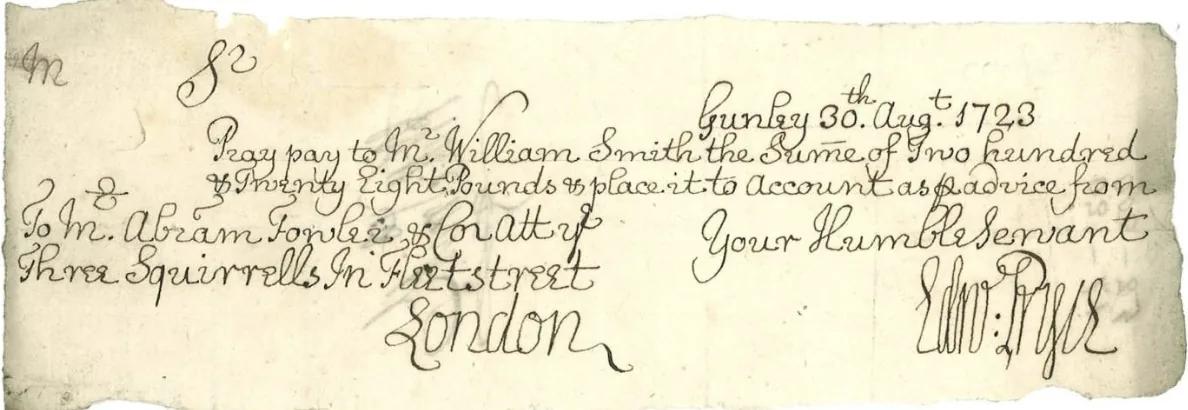
One of the earliest surviving bank cheques is still just a handwritten note. No printed bank name. No security pattern. The only real protection is that the banker knows the person.
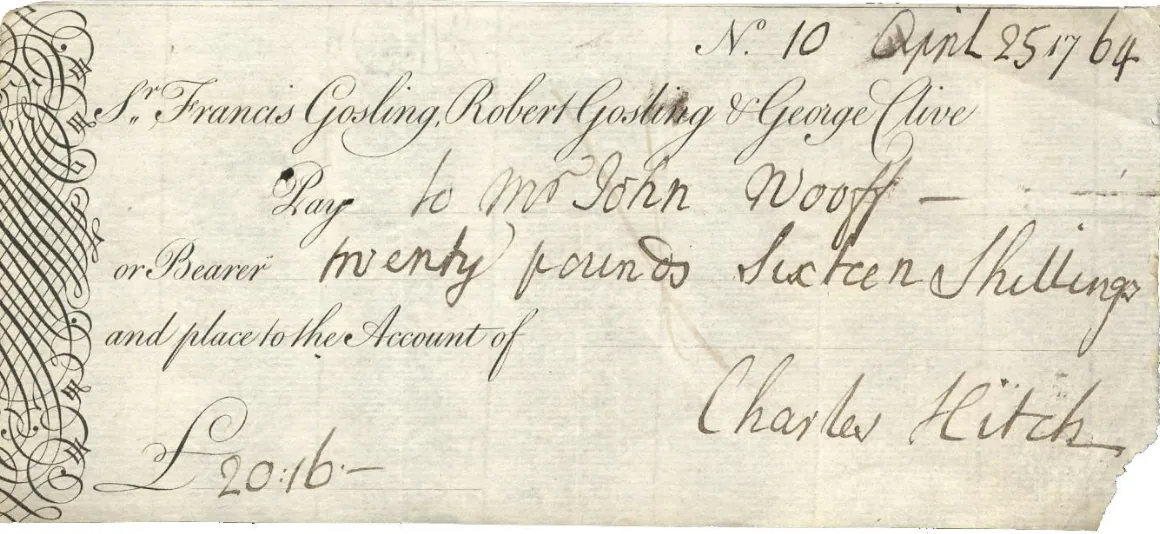
Printed cheques appear with the bank's name on them. Decorative swirls are added on the side, an early attempt to stop counterfeiting.
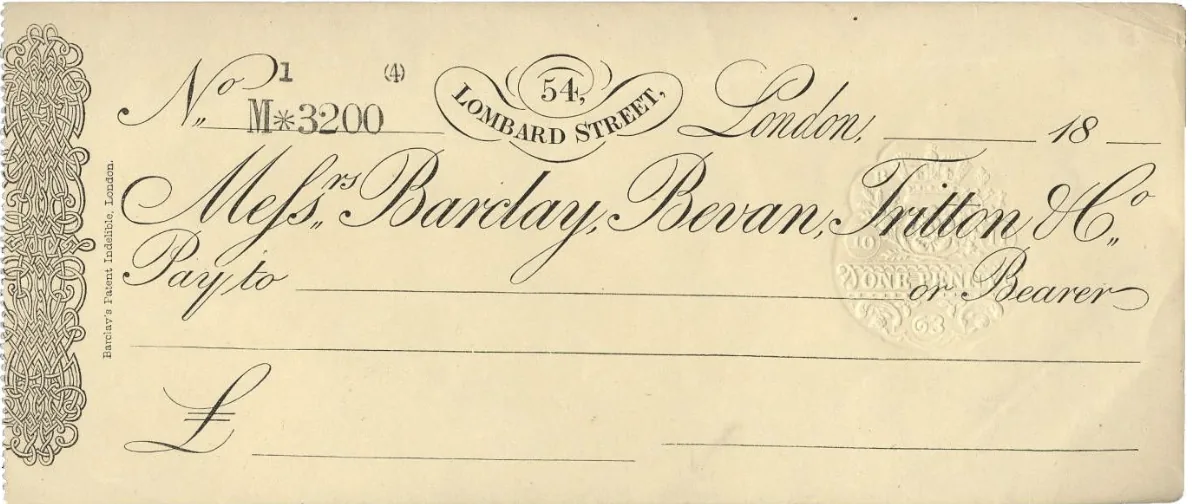
The cheque starts looking modern. Account numbers are stamped on. Perforated edges show it came from a cheque book. The Bank of England had introduced books of 50, 100, and 200 forms back in 1830.
Cheques also record company history. One Barclays cheque from this year moves money from the old private partnership into the new public company.

As banks merge, old bank names still appear on branch cheque books. Stamp duty, a small government tax charged on the cheque paper itself, is still charged. That tax later disappears in 1971.
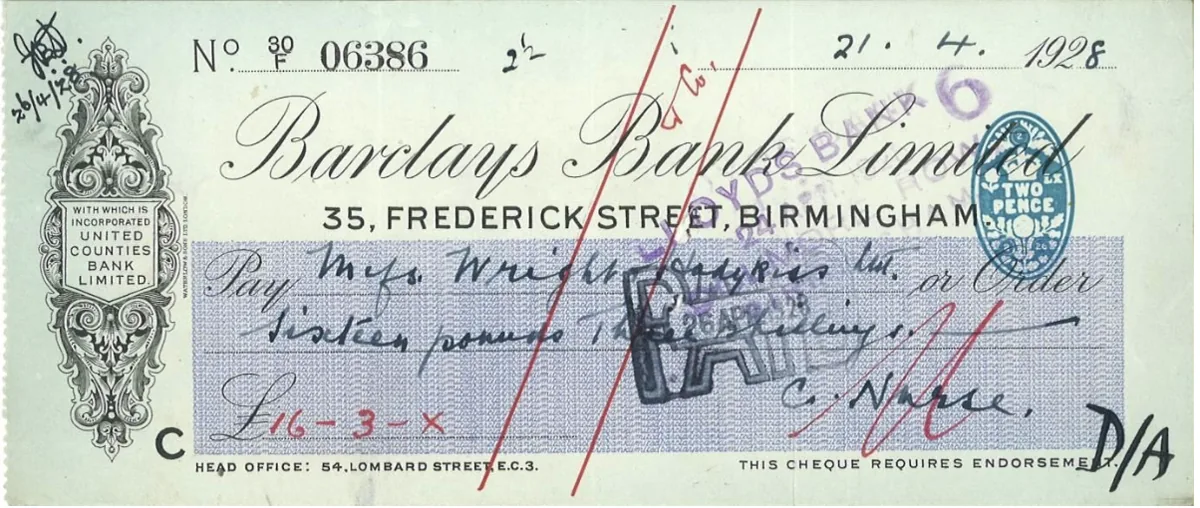
Wartime banking leaves a mark. Cheques are photographed on microfilm for the first time, so copies exist if the paper is lost.

Volume becomes too big for people to sort by hand. Magnetic ink numbers arrive: MICR, a line of numbers printed in special ink that machines can read. That line includes a nine-digit code telling the machine which bank the cheque belongs to, plus the account and cheque number. Machines can now read cheques at hundreds per minute.
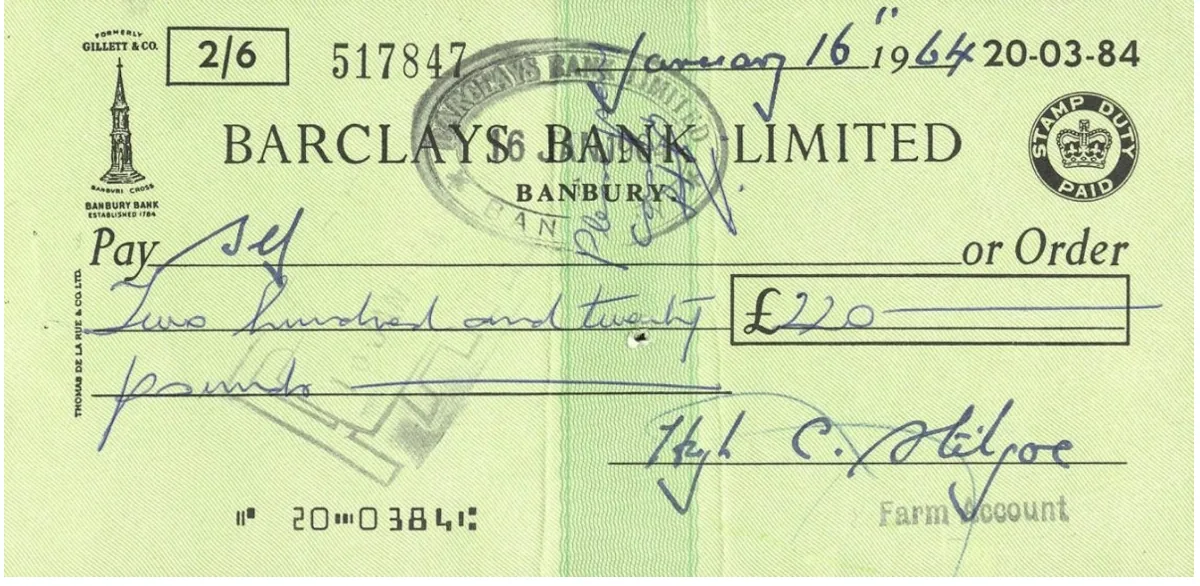
Cheques get stricter standards: stronger paper, fixed layout, readable fonts. MICR now covers sort code, account number, and cheque number. Clearing speeds up again.

Peak paper. About four billion cheques are written in the UK that year. After this, use starts falling.
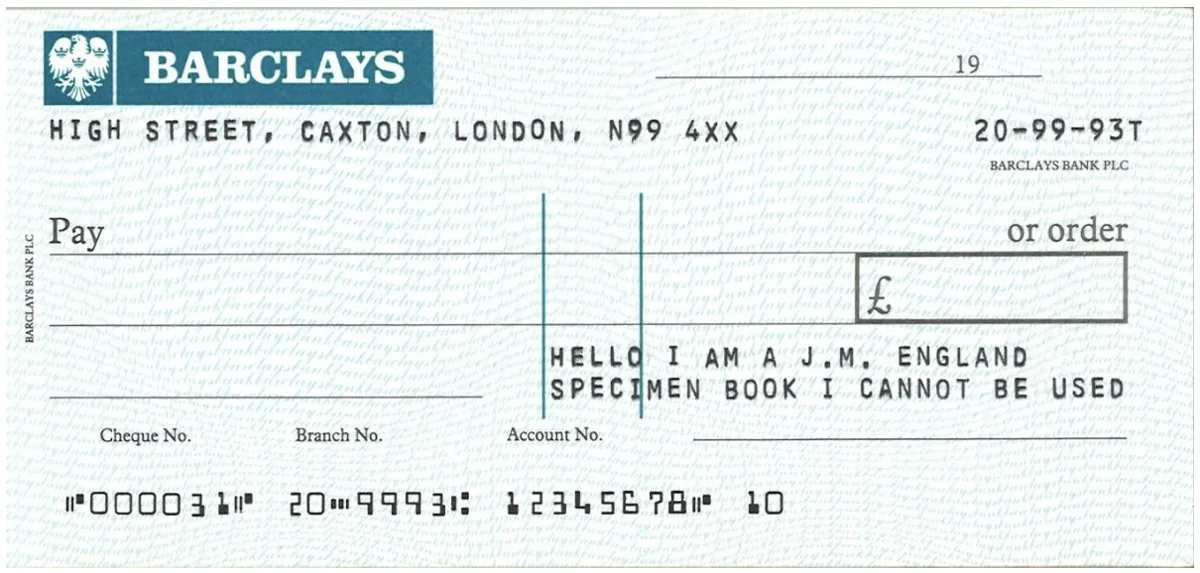
Banks stop doing as many manual checks in branches. More cheques go through the main clearing process.
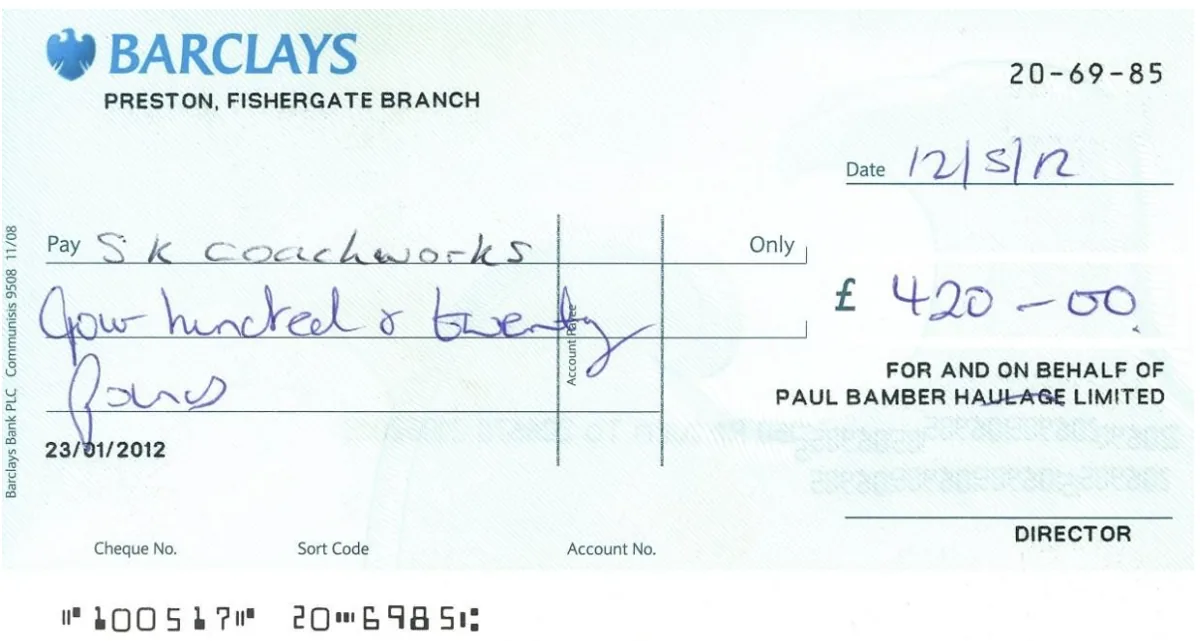
The biggest change since automation: take a photo. Mobile deposit lets you pay a cheque into an account from a phone. The paper becomes an image.

A cheque looks simple. Every line has a job.
In short: you order your bank to pay someone. The date, amount, name, and signature make it valid. The numbers at the bottom help machines move it through the system.
Cheque use peaked around 1990. Then cards, bank transfers, and phones took over.
Cheques are expensive for banks to process. Many countries phased them out. New Zealand stopped accepting them in 2020. Australia plans to remove them by 2030. In much of Asia and Europe, they were never an everyday tool for ordinary people.
They did not vanish everywhere. The UK, France, Ireland, the US, and India kept them longer. In the US, people now write far fewer cheques than in 2000, but when they do, the amounts are often larger: rent, contractors, one-off payments.
The cheque adapted again. Banks stopped moving as much physical paper. They scanned it. Then they let you photograph it on a phone.
The cheque was never just paper. It was a workaround for trust, distance, and risk.
People first left their money with goldsmiths because carrying metal was unsafe. Then they stopped withdrawing that money at all. They wrote an order instead. That order became the cheque.
First it replaced bags of metal. Then it became a printed form. Then a machine-readable slip. Then a photo on a phone.
The next time you see one, remember: it started as a letter to the person holding your gold.
What should we explore in Origins Issue #6? ATMs? Debit cards? Online banking? Reply and tell us.
— Your Origins team
Thanks for reading. See you next issue!
