


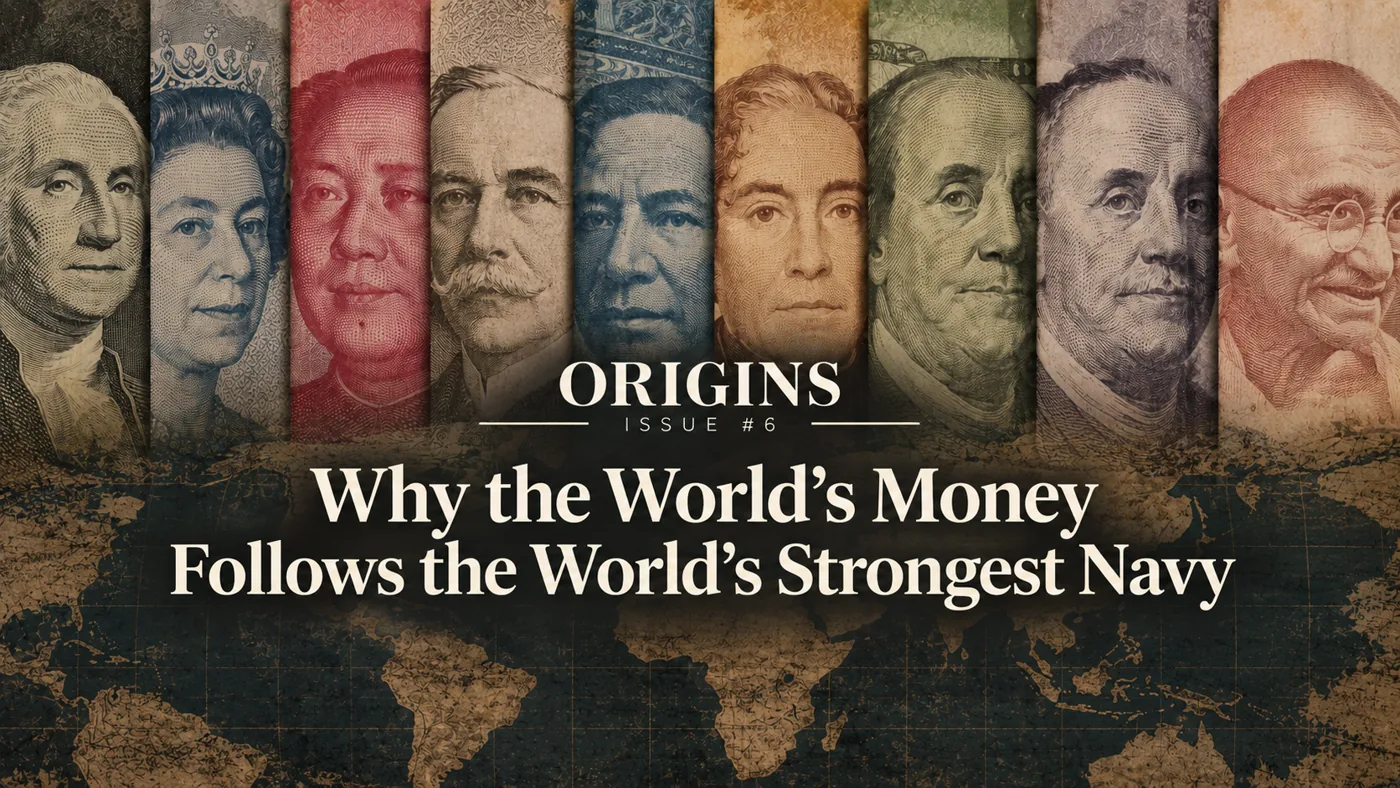
Picture this: A country can have factories, ports, and a booming economy. That is still not enough to make its currency the one everyone else wants to hold.
A reserve currency is the money other countries keep on purpose — in central banks, trade contracts, oil deals, and emergency savings. It is the currency people reach for when they do not want to argue about whose money to trust.
Welcome back to Origins. We have followed credit cards, Visa, Mastercard, credit scores, and cheques. Today: how one national currency becomes the world's backup money — and why military power, not just economic size, usually decides which one wins.
The world's reserve money has always travelled with the power that could protect trade.
Think of it as the world's preferred promise to pay.
Importers and exporters price goods in it. Banks lend in it. Governments park reserves in it. In a crisis, people run to it, not away from it.
That status is valuable. Other countries need the reserve currency to pay for trade. The country that issues it can borrow more cheaply and buy goods with money the rest of the world is already hungry to hold.
There is another benefit called seigniorage. Imagine printing a $100 note that costs just a few cents to produce, then using it to buy $100 worth of goods. The difference is seigniorage. When people abroad hold those dollars rather than spend them, the US effectively receives an interest-free loan. That is an additional privilege of issuing the world's reserve currency.
For a currency to get there, three things usually line up:
The third one is the part people skip. Money follows trust. Trust follows power.
Reserve currencies have come and gone with changing geopolitical order.
Before paper money dominated, the world settled in metal. Greek drachmas, Roman denarii, Byzantine gold, Islamic dinars, Venetian ducats, and Florentine florins all had their moments because the states behind them were central to trade.
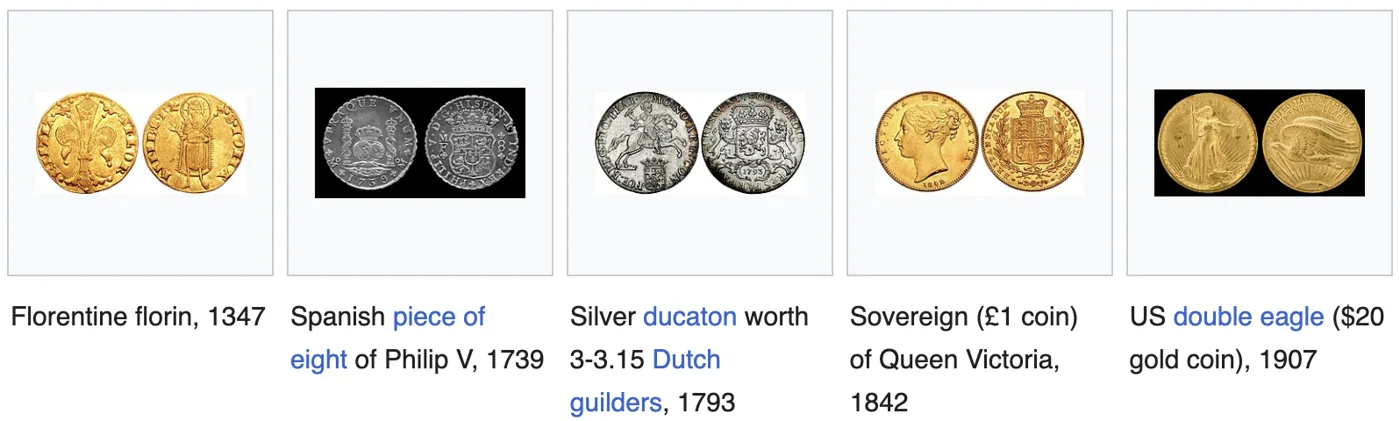
Then came the first truly global coin: the Spanish silver dollar, fed by mines in the Americas and carried by Spanish power across Europe, Asia, and the New World.
The Dutch guilder followed in the 1600s, backed by Dutch trade, Dutch ships, and an early version of modern banking in Amsterdam.
There was no single reserve currency that neatly replaced the guilder before sterling. The shift happened gradually through the 1700s and early 1800s as Dutch financial dominance declined and Britain's trade, naval power, and financial markets expanded.
Sterling was the dominant trade currency, and Britain was the workshop of the world. Over 60% of world trade was invoiced in pounds. London was the centre for insurance, commodities, and foreign investment.
The gold standard of that era was, in practice, a sterling-gold system. The pound could be converted into gold at a fixed rate. But gold did not have to travel across the sea every time a payment was made. Most trade was financed and settled through sterling bills and sterling bank deposits in London. Those were claims on money in London, not crates of gold moving with every shipment. Gold was the anchor underneath. Sterling was the working currency on top.
Not because America had just become rich. America was already the largest industrial economy by the late 1800s. The dollar took over later, in the mid-20th century, because America became the country that could underwrite the post–Second World War order.
By the late 1800s, the United States had already overtaken Britain in industrial output. The dollar still was not the world's reserve currency.
Reserve status is sticky. Banks, contracts, and habits stay with old money until something big breaks the old system.
From about 1870 to 1914, the world operated on the classical gold standard. Major currencies could be converted into gold at fixed rates. Sterling sat at the centre of global trade and finance, but gold remained the ultimate anchor of the system.
What broke that order was not a spreadsheet. It was war.
World War I weakened the gold standard and drained Britain. Countries tried to restore the old gold rules in the 1920s. It did not last. In 1931, Britain stopped promising to convert pounds into gold on demand. That is what "left gold" means: the pound was no longer tied to a fixed amount of gold.
World War II completed the shift in economic power. Britain had accumulated debts and no longer had enough gold to sit at the centre of the system. America had factories, much of the world's gold, and the military capacity to underwrite a new order.
In 1944, at Bretton Woods, that power was written into the rules. Other currencies were pegged to the dollar, and the dollar was pegged to gold at $35 an ounce.
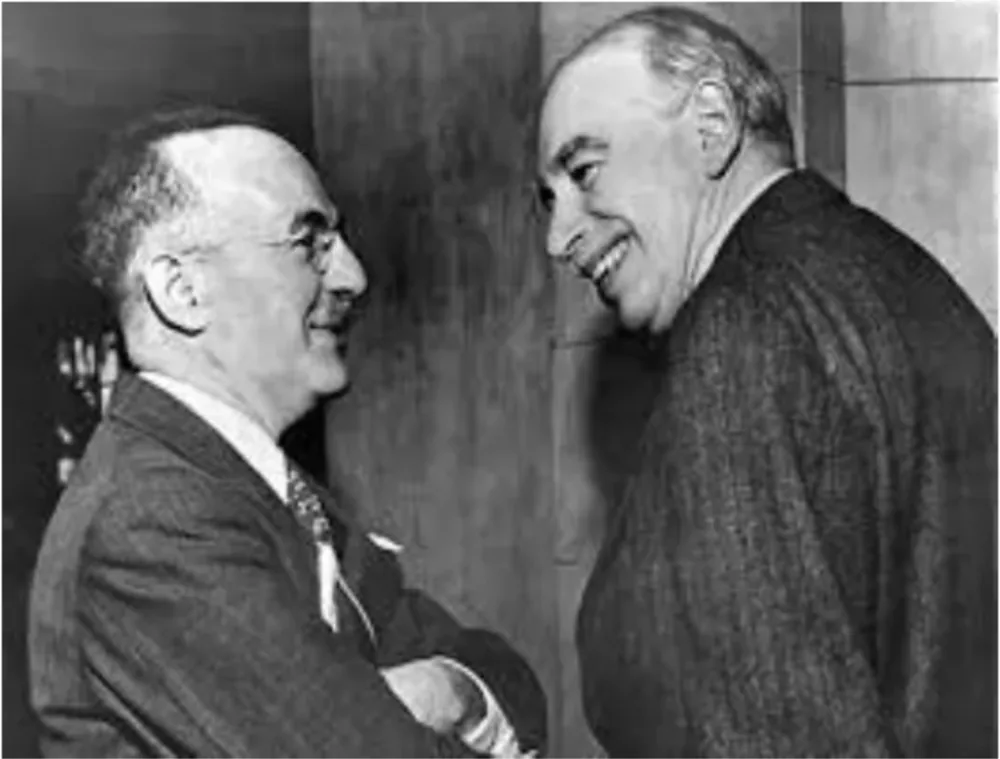
That was not yet a fiat-dollar system.
Under Bretton Woods, other countries held dollars because those dollars could still be swapped for gold at $35 an ounce. The final break came in 1971, when the United States ended that promise. From then on, the dollar itself, rather than gold, became the system's primary anchor.
Why did America break the gold link? Because the system could not last.
The world needed more dollars to trade and to hold as reserves. That meant America had to send dollars abroad. At the same time, US spending at home and abroad — including the Vietnam War and Great Society programmes — put even more dollars into the world. Foreign governments started asking for gold instead of paper. America's gold stock could not cover all the dollars outstanding.
Keep the gold promise, and the US risks running out of gold. Keep sending dollars into the world, and the promise becomes unbelievable. That contradiction is why the gold standard, in that form, was not sustainable.
The world did not vote the dollar in only because of America's economic size. It accepted the dollar because the United States could feed, finance, and defend the system. After 1971, countries kept using it because the markets, the habits, and the power around the dollar were already in place.
Economic size creates the currency. Military power helps protect the order around it.
A reserve currency needs:
Spain's silver travelled with Spanish power.
The guilder travelled with Dutch commercial and naval power.
Sterling travelled with the Royal Navy and the City of London.
The dollar travelled with American military victory, American gold, and institutions that became deeply embedded in global trade and finance.
When Britain's military and financial power cracked, sterling faded slowly. In 1965, the pound was still about 26% of allocated reserves. By 1970 it was about 11%. Today it is about 4–5%.
Reserve currencies do not disappear solely due to fading military dominance. They fade when the political, financial, and institutional order behind them begins to lose its hold.
In 1971, America suspended the dollar's convertibility into gold for foreign governments and central banks. Too many dollars were circulating abroad relative to America's gold reserves, and countries were increasingly exchanging those dollars for gold.
But that did not end the American dollar's dominance.
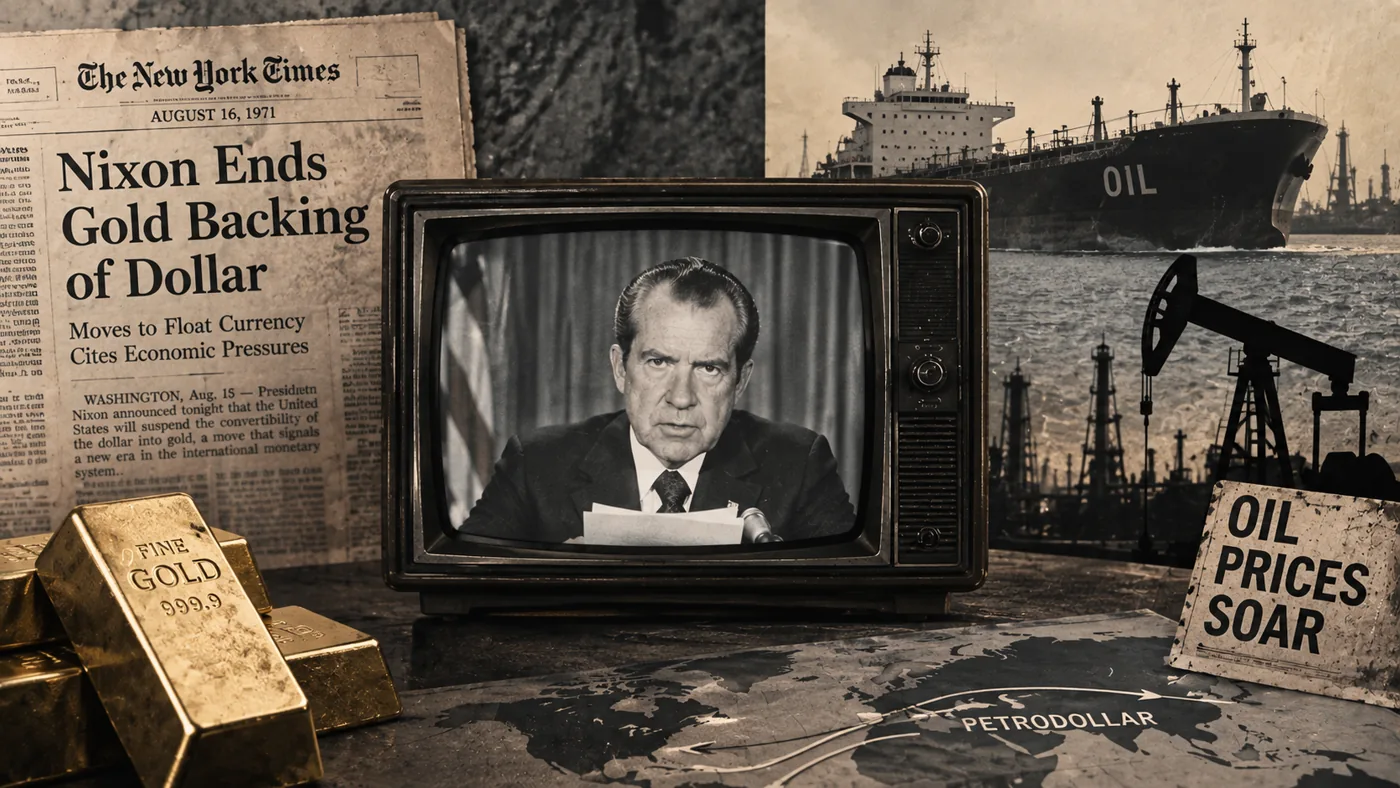
By then the world already invoiced trade in USD, held USD reserves, and depended on USD markets. After the 1970s oil shocks, the United States and Saudi Arabia struck a bargain that became known as the petrodollar system: oil would be priced and sold in dollars, and a large share of those oil earnings would flow back into US assets. If you needed energy, you needed dollars. Those dollars then returned to American markets.
The dollar-gold link ended. The power structure around the dollar did not.
But that created a tension Robert Triffin had identified years earlier. The world needed a growing supply of dollars to trade and save. Supplying those dollars meant America had to keep sending dollars abroad through current-account deficits. Persistent fiscal deficits can add to that pressure by raising debt and inflation concerns.
That is the paradox: the world needs America to supply dollars, but too many dollars plus weak fiscal confidence can threaten the privilege that creates that demand.
The gold window closed. The dollar stayed.
No. It is smaller than it was, far from finished. The dollar is the currency of denomination for trade and financial transactions by a wide margin. But it is less alone in that league from what it used to be.
Share of allocated global foreign-exchange reserves:
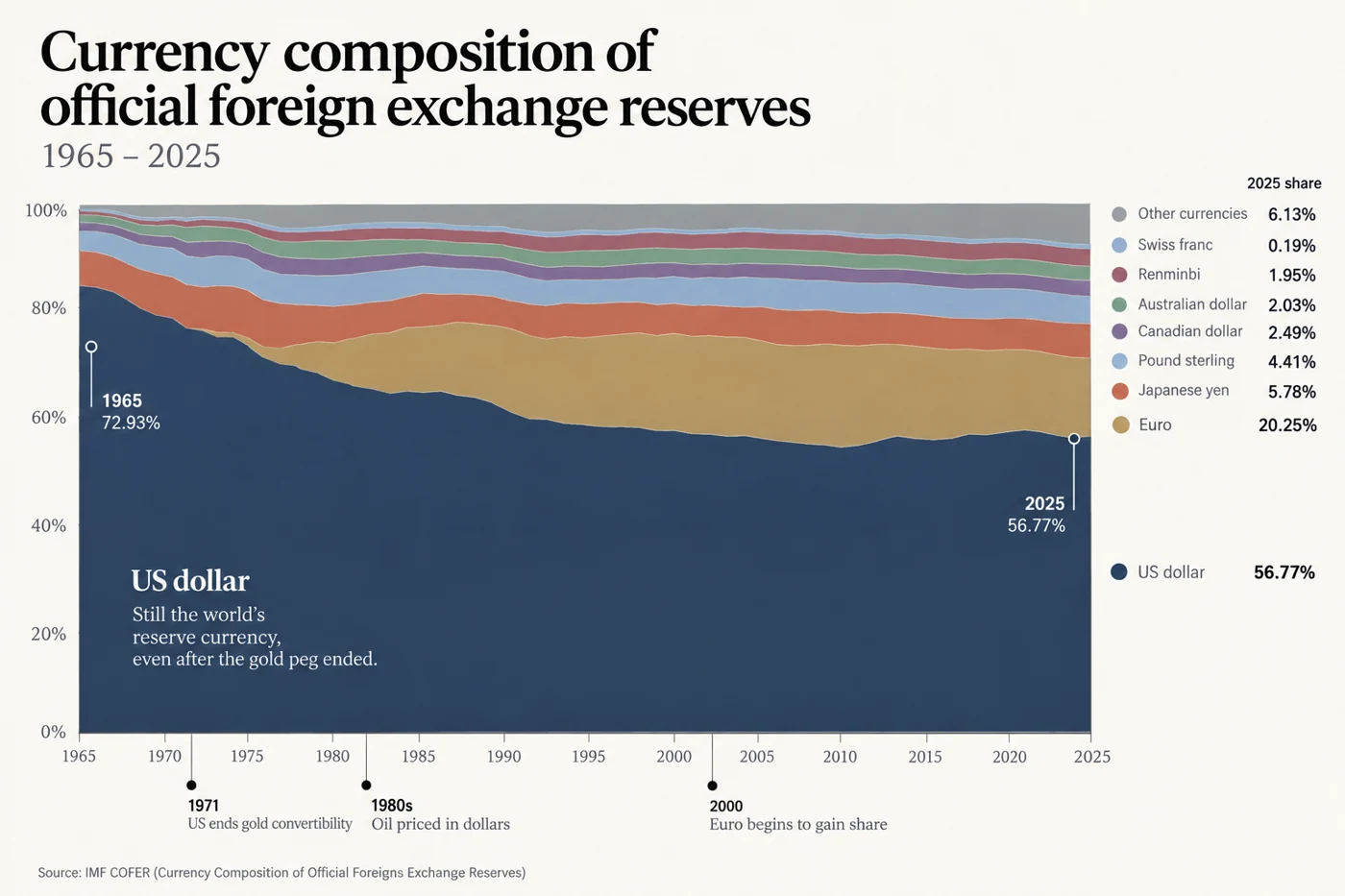
Read that chart carefully. The dollar has slipped from roughly seven-tenths of reserves to a little under six-tenths. The euro is a distant second. Sterling, once the world's key currency, is now a small slice. The renminbi is visible, but still tiny.
Reserve currencies fade after the power behind them fades, and they fade slowly. Sterling did not collapse the year America became the biggest economy. It faded after two wars. The dollar's share has slipped. That is a warning, not a funeral.
| Stage | What happens | Why power matters |
|---|---|---|
| 1. Trade lead | The country becomes central to world commerce | People need its markets |
| 2. Financial depth | Bonds, banks, and contracts become easy to use | People can park money there |
| 3. Military umbrella | Sea lanes, allies, and settlements are protected | People trust the system will hold |
| 4. Habit | Everyone prices, saves, and borrows in that currency | Switching becomes expensive |
| 5. Lag | A new economy can rise for decades before its currency takes over | The old power's money stays until a shock |
A reserve currency is not a prize for having the most factories. It is a prize for being the country others can depend on when things break.
Economic size builds the case. Military power helps protect the order around it. Neither one is enough on its own. Markets, trusted institutions, and the ability to keep trade moving all have to sit behind the money.
That is why Spain, the Netherlands, Britain, and the United States did not just grow rich. They could protect the trade that made their money useful. And that is why the dollar replaced sterling after two world wars, a good number of years after America became the largest economy.
The next time someone says "the biggest economy will have the world's currency," remember the lag. Money is slow. Power is what finally moves it.
What should we explore in Origins Issue #7? The gold standard? Bretton Woods in more depth? Central banks? Reply and tell us.
— Your Origins team
