


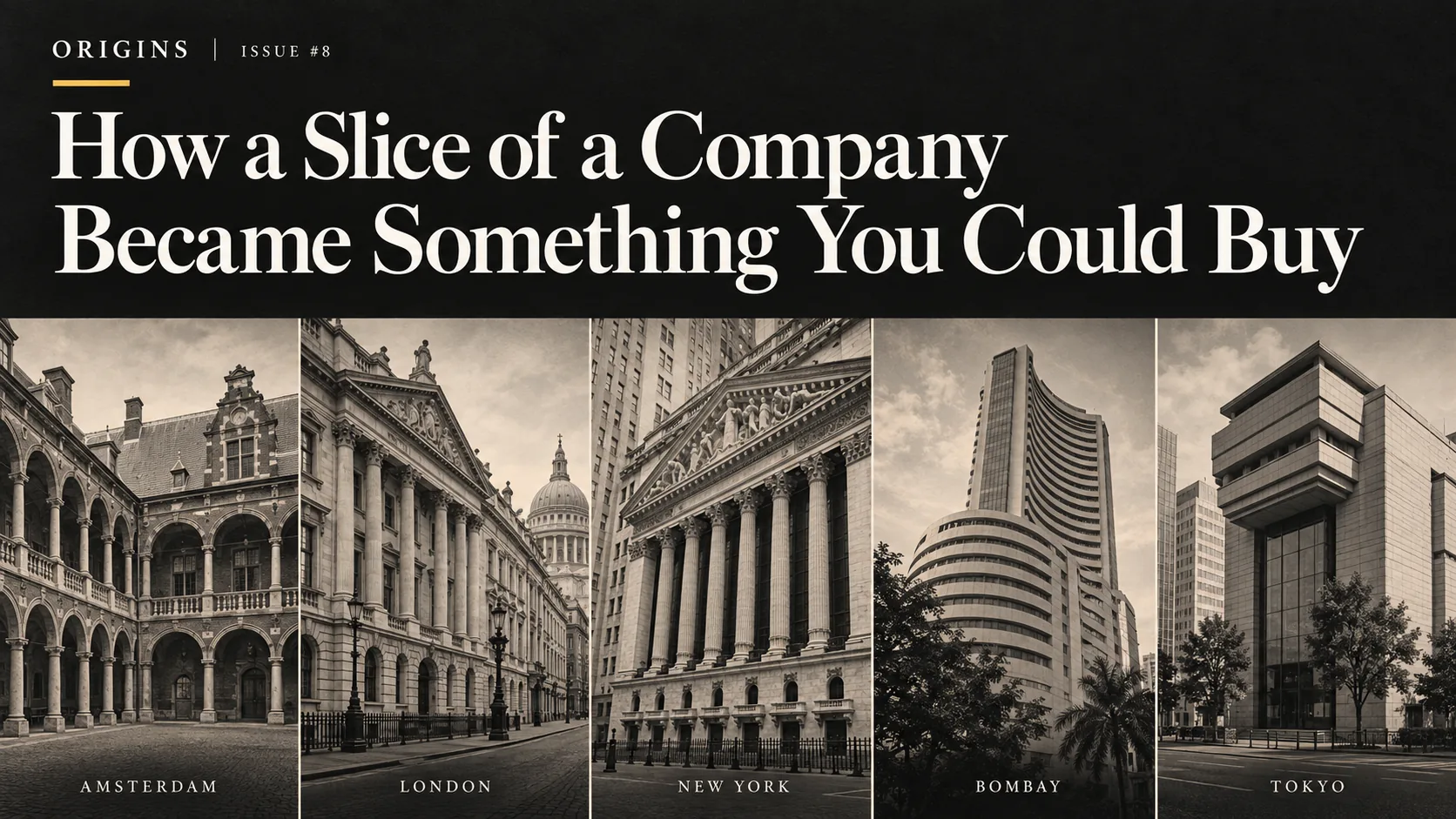
Picture this: A ship is about to sail for Asia. The voyage will take years. It might sink. It might return with spices worth a fortune. Merchants need money for the trip. Instead of one rich man funding the whole ship, many people put in a little. If the ship comes back, they share the profit. If it does not, they share the loss.
That was already old. What was new, in Amsterdam in 1602, was that you could sell your piece of the company to someone else without waiting for the ships to return. Your money could leave. The company kept the capital.
Welcome back to Origins. Today: how stock exchanges began.
For centuries before permanent companies, through the 1400s and 1500s merchants funded single voyages. You put money in to buy a share of that trip’s gains and losses. When the ship came home, you took your portion and the partnership ended. Next voyage, start again.
In March 1602 the Dutch government chartered the Dutch East India Company (Vereenigde Oostindische Compagnie, or VOC). It was a forced merger of earlier trading companies, with a monopoly on Dutch trade to Asia.
The charter said any resident could buy a share. There was no minimum amount — one guilder or more was enough. Shares had no fixed size. You bought a claim for a certain sum, not a set number of units. In August 1602, about 1,143 people in Amsterdam alone subscribed, raising roughly 3.7 million guilders. One investor was a maid who put in 100 guilders — about 200 days’ wages.
The price was not calculated by the company. Buyers and sellers agreed it. Because every claim was a different size, the market quoted the price as a percentage of the amount the investor had first paid in 1602, set at 100. A price of 106 meant the claim was worth 6 percent more than the investor had first paid.
Ownership lived in the company’s ledgers. There was no paper certificate at first. Your name and the amount you had paid were written in the capital book. That entry was the proof you owned the claim. To sell, you and the buyer went to the bookkeeper. Two directors witnessed the transfer, and the ledger was updated. By 1606, when the last installments were paid, the company issued receipts. Those scraps of paper are among the oldest share documents that survive. They were proof of payment, not the share itself. The ledger still decided who owned what.
Trading happened on a bridge, then in a purpose-built exchange building opened in 1611, and after hours in Dam Square on news and rumours. Amsterdam had a market in company shares. That is why it is usually called the world’s first modern stock exchange.
In 1688 an Amsterdam trader, Joseph de la Vega, published Confusion of Confusions — the first book that tried to explain how a stock market works. It is written as four dialogues between a philosopher, a merchant, and a shareholder. De la Vega describes puts, calls, forward deals, rumours, and the tricks traders used to push prices up or down. He wrote it in Spanish for a small educated circle in Amsterdam, not as a wide public manual. It was little read at the time and stayed obscure for two centuries. Only a handful of the 1688 copies survive. Later historians rediscovered it as the earliest clear account of a working share market.

In London, share dealing grew in coffee houses. Jonathan’s Coffee House in Exchange Alley, opened around 1680, became the place. Brokers who had been thrown out of the Royal Exchange for noise moved there.
In 1698 a broker named John Castaing began posting lists of stock and commodity prices at Jonathan’s. He called the list “The Course of the Exchange.” It appeared twice a week and showed government stocks, company shares, and exchange rates. It was the first regular public price list in London.
Through the early 1700s the market stayed in coffee houses. In 1711 the South Sea Company was chartered to trade with Spanish America. Its shares rose on the promise of riches from trade that had not yet happened. By 1720 the price had soared far beyond any realistic return. People bought because the story was strong and the price was rising, not because the company’s books justified it. That is what “prices running on a story alone” means. When the story broke, the South Sea Bubble collapsed. Many investors were ruined. Parliament passed the Bubble Act, which restricted new share issues. Trading continued, but quieter.
In 1761 a club of about 150 brokers formed at Jonathan’s to limit who could trade. In 1773 they moved into their own building in Sweeting’s Alley, briefly called New Jonathan’s, then renamed the Stock Exchange. In 1801 it reopened on a formal membership basis — the modern London Stock Exchange.

After the American Revolution, the new government issued bonds in 1790 to fund the war debt. Banks and insurance companies issued shares. Trading happened in streets, coffee houses, and auctions.
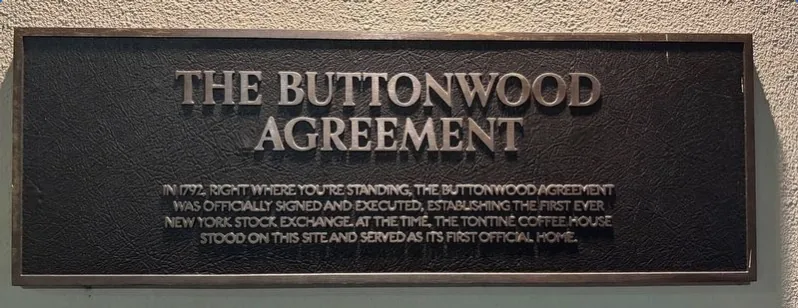
On 17 May 1792, 24 brokers signed the Buttonwood Agreement. They promised to deal with each other in preference to outsiders, and not to charge less than a quarter of one percent commission. The legend says they signed under a buttonwood tree on Wall Street. The agreement is real; the exact spot under the tree is less certain.
It was not yet a full exchange. It was a club to stop undercutting and chaos. In 1817 the group organised as the New York Stock and Exchange Board, with rules and a constitution. That is the direct ancestor of the NYSE.
In Bombay in the 1850s, a handful of brokers met under a banyan tree near the Town Hall. They traded shares in the open. There was no building and no formal association.
Premchand Roychand, a young broker who became known as the Cotton King during the American Civil War boom, was among the leading figures. Numbers grew. The group moved from place to place. On 9 July 1875 they formed the Native Share and Stock Brokers’ Association — the start of the Bombay Stock Exchange, Asia’s oldest.
They hired a trading hall and settled on what became Dalal Street — broker street. Through the late 1800s and early 1900s the association stayed a private brokers’ club. It wrote its own rules, moved into a permanent building, and grew with Bombay’s cotton and industrial trade. The Indian government formally recognised it as a stock exchange only in 1957, under the Securities Contracts Regulation Act.
In 1995 the Bombay Stock Exchange (BSE) switched from open outcry — brokers shouting prices on the floor — to electronic trading. The change took about 50 days. That was fast. Most exchanges needed years to move from a physical floor to screens. The BSE did it in weeks, and the old trading floor went quiet almost overnight.
An exchange is not the company. It is the meeting place — and the rules of that meeting — where claims on companies can be bought and sold. The rules decide who may trade, what commission they charge, and how a deal is recorded so both sides can trust it.
A company raises money when it first sells shares. That is the primary market. The exchange is mostly the secondary market: people buying and selling those shares from each other. The company does not get the money on those later trades. The investor who wants out does.
Three things made the difference:
That is why a stock exchange is infrastructure, not a product. Once shares could move, capital could stay in the company while investors came and went.
| Year | What happened | Why it mattered |
|---|---|---|
| 1602 | VOC chartered; public subscription in Amsterdam | First permanent company with tradable shares |
| 1611 | Amsterdam exchange building opens | A place for the market |
| 1688 | de la Vega’s Confusion of Confusions | First book on how a stock market works |
| 1698 | Castaing posts prices at Jonathan’s, London | Organised share prices in London |
| 1720 | South Sea Bubble | Speculation can break a market |
| 1773 | London brokers name their building the Stock Exchange | Coffee house becomes an institution |
| 1792 | Buttonwood Agreement, New York | 24 brokers form a trading club |
| 1801 | London Stock Exchange on formal membership | Regulated exchange in London |
| 1817 | New York Stock and Exchange Board | Rules and constitution for New York |
| 1850s | Brokers under a banyan tree in Bombay | Informal share trading in India |
| 1875 | Native Share and Stock Brokers’ Association | Start of the BSE, Asia’s oldest exchange |
| 1878 | Tokyo Stock Exchange opens | Japan’s main market |
| 1891 | Hong Kong Stock Exchange | |
| 1961 | Taiwan Stock Exchange | |
| 1971 | Nasdaq | First electronic exchange |
| 1990 | Shanghai Stock Exchange | Modern reopening; earlier market from the 1890s |
| 1990 | Shenzhen Stock Exchange | |
| 1992 | National Stock Exchange (India) | Electronic from the start |
| 2000 | Euronext | Merger of Amsterdam, Paris, Brussels, and later others |
The oldest are not always the biggest. This is the ranking by market value of listed companies, May 2026.
| Rank | Stock exchange | Country | Market capitalization (in trillion US dollars) |
|---|---|---|---|
| 1 | Nasdaq | United States | 34.99 |
| 2 | New York Stock Exchange | United States | 30.96 |
| 3 | Shanghai Stock Exchange | China | 10.18 |
| 4 | Euronext | European Union | 8.67 |
| 5 | Tokyo Stock Exchange | Japan | 7.64 |
| 6 | Shenzhen Stock Exchange | China | 6.36 |
| 7 | Hong Kong Stock Exchange | Hong Kong | 5.85 |
| 8 | National Stock Exchange | India | 4.34 |
| 9 | Bombay Stock Exchange | India | 4.33 |
| 10 | Taiwan Stock Exchange | Taiwan | 3.23 |
Amsterdam invented the share market. New York and London scaled it. Bombay, Tokyo, and Hong Kong built Asia’s early floors. Nasdaq, Shanghai, Shenzhen, and the NSE arrived in the electronic age. Euronext is the old European exchanges under one roof.
A stock exchange did not start as a temple of finance. It started because a voyage to Asia was too big for one merchant, and because the people who put money in wanted a way out without sinking the company.
Amsterdam solved the share. London turned coffee-house dealing into a named exchange. New York turned a street club into rules. Bombay turned a banyan tree into Asia’s oldest exchange. The idea is the same: a claim on a company that someone else will buy from you.
The next time you see a stock price, remember the maid in Amsterdam who put in 100 guilders, the brokers under a tree in New York, and the brokers under a banyan tree in Bombay.
What should we explore next? Central banks? Insurance? The bond? Reply and tell us.
— Your Origins team
