


Picture this: A city needs money for a war. It does not sell a slice of itself. It asks its wealthiest citizens for a loan, promises to pay interest forever, and lets them sell that promise to someone else if they need cash sooner.
Welcome back to Origins. Last time we followed shares from a single voyage to the first stock exchanges. Today we turn to the other claim: not ownership, but a loan. The bond.
For most of history, a ruler borrowed from a banker or a rich merchant. The loan was personal. If the ruler died or refused to pay, the lender was left holding nothing. Cities in northern Italy found a different way.
In 1171, the Byzantine emperor ordered the arrest of Venetian merchants in Constantinople and the seizure of their property. Venice began preparing for a military expedition against the Byzantine Empire, which required substantial funding. To raise the money, the city imposed compulsory loans, known as prestiti, on its wealthier citizens, with contributions based on their wealth. Unlike a tax, these loans created a claim on the government, with the possibility of receiving interest and eventually getting some of the money back. That didn't mean citizens welcomed being forced to lend, but they had a financial claim in return rather than simply paying a tax.
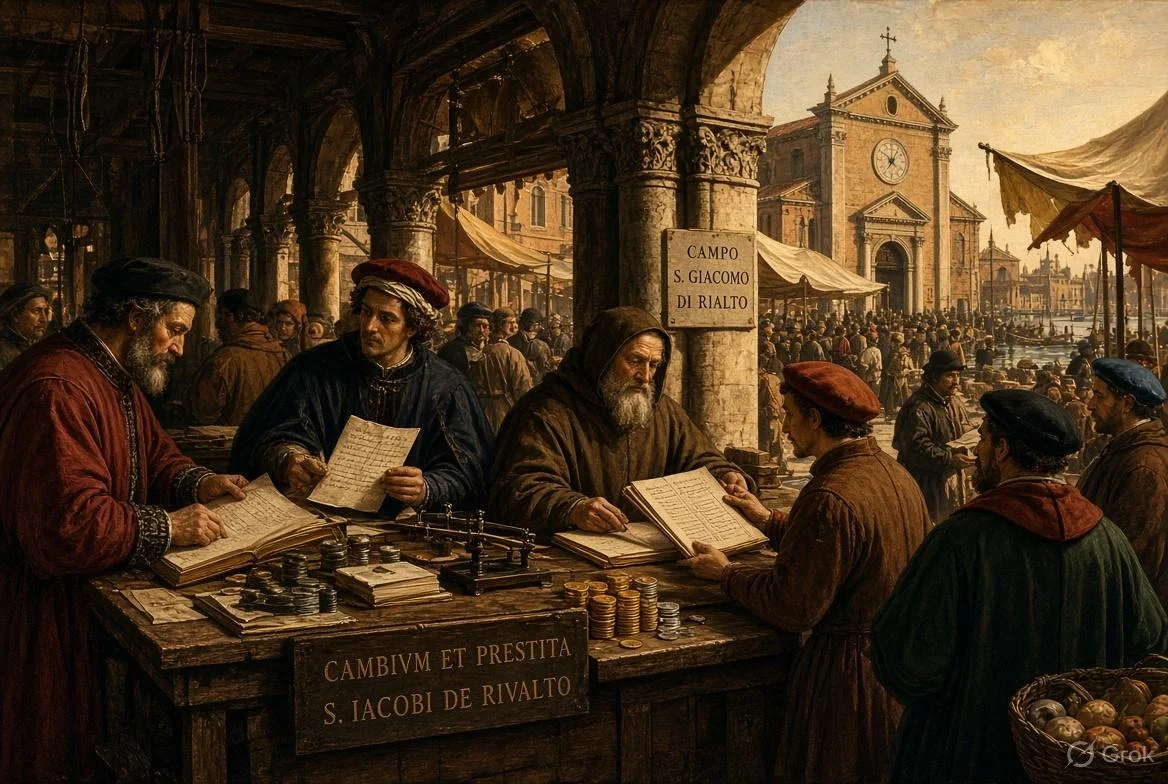
In 1262 Venice consolidated the outstanding loans into one permanent fund, the monte vecchio. It paid 5 percent a year in two installments. There was no fixed maturity. The government could redeem the claims when it chose, but it was not obliged to. Ownership was recorded in ledgers kept by the Loan Officers. You proved you held a claim by the entry in the book, not by a piece of paper you carried. Because the ledger could be updated, you could sell your claim to someone else. Buyers and sellers met near the Rialto. That is the practical step that turned a forced loan into something that worked like a bond: a claim that could be traded. Historians call Venice the first place with a real market in government debt.
Forced loan (1171) → temporary interest-bearing claim → consolidated into a permanent fund (1262) → ledger entry that could be transferred → tradable bond.
Genoa did something similar. Its luoghi were also perpetual claims. In 1407 creditors pooled their holdings into the Casa di San Giorgio. The Casa managed the debt and was given the right to collect certain taxes. Those taxes paid the interest on the debt. Florence consolidated its forced loans into the Monte Comune in the 1340s. It also paid around 5 percent and let the claims trade.
In each case, the government needed money, and citizens provided it, sometimes because they were required to and sometimes because they wanted to earn interest. But once the money was lent, the citizen held a claim against the government. Suppose someone had been forced to lend 100 florins but needed that money back before the government was ready to repay. Instead of waiting, they could sell their claim to another person. The buyer would pay for the claim and receive the future interest payments. The original lender got cash, while the government's debt simply passed to a new holder. That is how even a compulsory loan could become something people bought and sold voluntarily.
The Dutch took the idea further. Provinces and water boards issued perpetual annuities. You paid money once. You, or whoever held the bond later, received interest every year with no end date. These were already in bond form: a clear promise of interest forever, and a claim that could be sold. One of those bonds is still alive.
In 1624 a Dutch water authority near Utrecht sold bonds to repair a broken dike. One 1,200-guilder bond went to a woman named Elsken Jorisdochter, in Amsterdam. It promised 2.5 percent forever. That bond still exists. The New York Stock Exchange owns it. The modern successor of the water board still pays the interest — now a few euros a year — because the original promise never expired. Most of the other bonds from that issue were redeemed or lost. This one survived wars, currency changes, and four centuries.

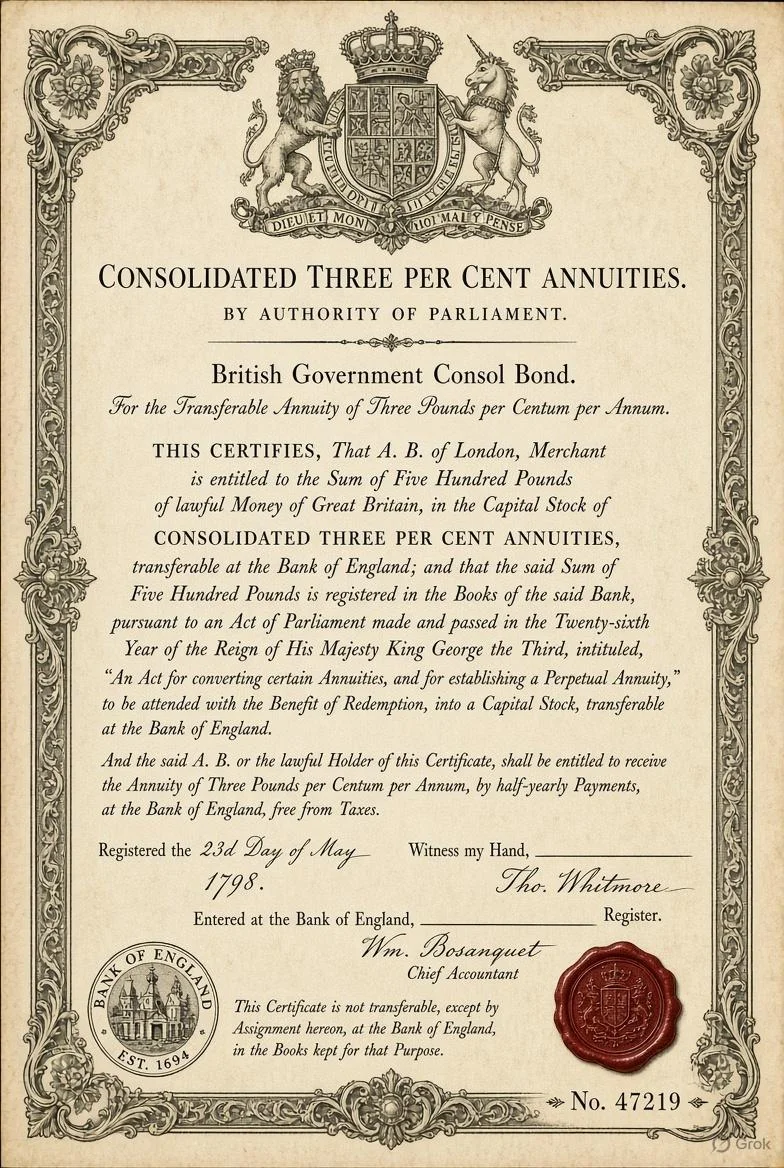
Britain regularised the same idea. In 1749 Henry Pelham consolidated a messy pile of earlier government loans into one series of perpetual bonds: the consols. They paid interest forever and could be redeemed only if the government chose. For more than a century they were the backbone of British public debt and a safe place for investors who wanted steady income without owning a company.
A share gives you a slice of a company. A bond gives you a claim on a fixed stream of payments. The company or government keeps ownership. You keep the right to interest and, if the bond has a maturity date, the right to get your principal back. If the issuer fails, bondholders usually rank ahead of shareholders.
That is why the bond sits next to the stock exchange in the story of capital markets. Shares let a company raise money by selling a piece of itself. Bonds let a government or company raise money by promising to pay it back. Both claims could be traded. Both turned a one-time need for cash into something investors could buy and sell.
Not every promise is equal. A city that has always paid its interest is a safer bet than one that has missed payments before. Rating agencies — Standard & Poor’s, Moody’s, and Fitch — try to measure that difference. They look at the issuer’s finances, its history of paying on time, and how much debt it already carries. Then they give the bond a letter grade.
The top grade is AAA. From there the scale steps down through AA, A, and BBB. Anything at BBB− or higher (or Baa3 on Moody’s scale) is called investment grade. Below that is speculative, or junk. The grade is an opinion about the risk that the issuer will not pay. It is not a guarantee, and it can change if the issuer’s situation changes.
A higher grade usually means a lower interest rate. Investors accept less yield when they believe the money is more likely to arrive. A lower grade means the issuer has to offer more interest to attract buyers. That is the trade-off the rating tries to capture: how safe is this promise, and how much extra do you need to be paid to hold it?
Before there were bond markets or stock exchanges, rulers could borrow directly from bankers or wealthy merchants. Merchants could also pool money to fund a voyage and split the proceeds when it returned. Both ways of raising money were already in use, but a market for tradable government debt took shape in Venice centuries before Dutch East India Company shares began trading in Amsterdam.
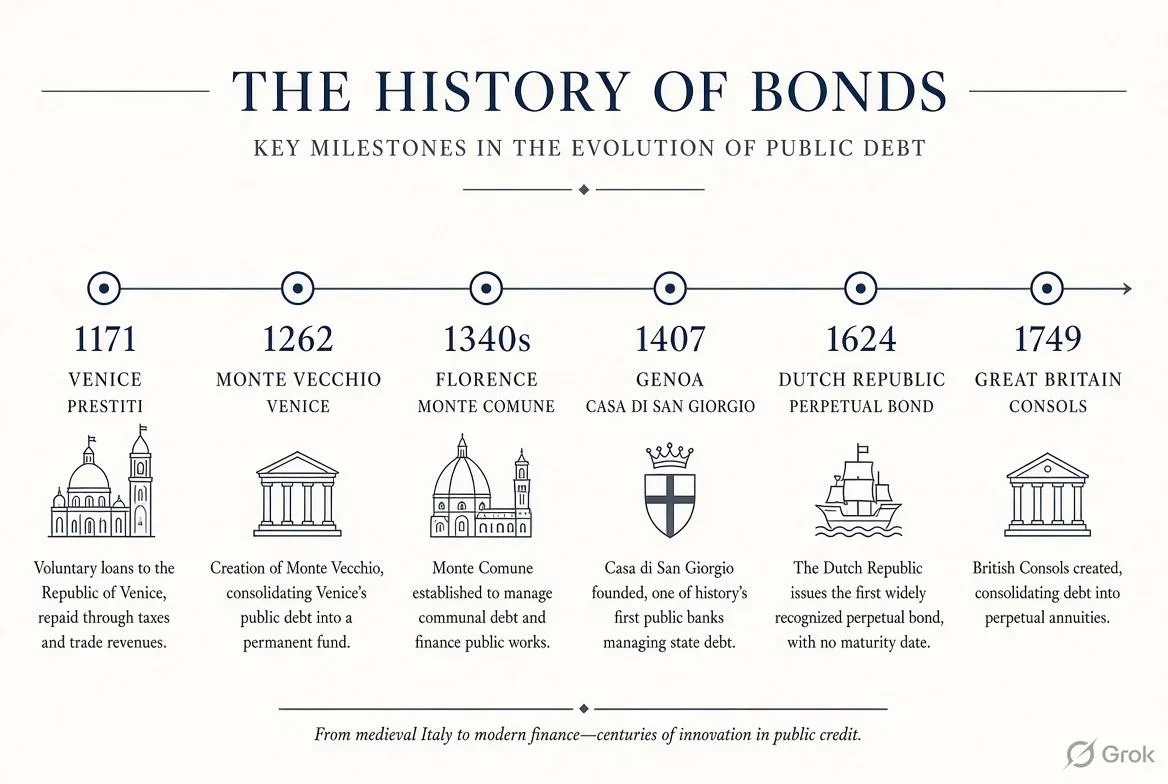
The timeline below starts with a loan that Venice required wealthy citizens to make. By the second Venetian milestone, in 1262, holders could sell their claims. That meant a lender who needed cash could find a buyer without asking the city to repay the loan. The later milestones show how other governments and public authorities used long-term debt to fund needs such as repairing Dutch flood defences or reorganising Britain's existing debt.
Why would a company issue bonds if selling shares already worked? Say an established trading company needs money for a new warehouse. If it sells new shares, those investors get a stake in the whole business, including the operations already making money. If it issues bonds, the existing owners keep their stakes and the company can use future sales to make the payments. Those payments are still due in a bad year. For an untested voyage, selling shares may make more sense because investors share the risk of what the voyage earns.
The bond began as a way for a city to fund a war without permanently raising taxes or selling itself. Making the claim tradable turned a forced loan into an investment. Governments discovered they could borrow from many people at once, and investors discovered they could exit without waiting for the original borrower to repay. That is still the core bargain: one side gets money now, the other gets a stream of payments, and both can trade the promise if they change their mind.
What should we explore next? Central banks? Insurance? Limited liability? Reply and tell us.
— Your Origins team
Thanks for reading. See you next issue!
